

How To Draw Landscape Digital Painting
Hey everyone. This video is brought to you past Clip Studio Pigment. A software I've been playing around a lot with lately. Today, I'll put it through its paces doing some photo studies. I'll share some tips as to how I get the most out of these sketches, and forth the way, I'll outline some features of Clip Studio Paint I remember are really cool.
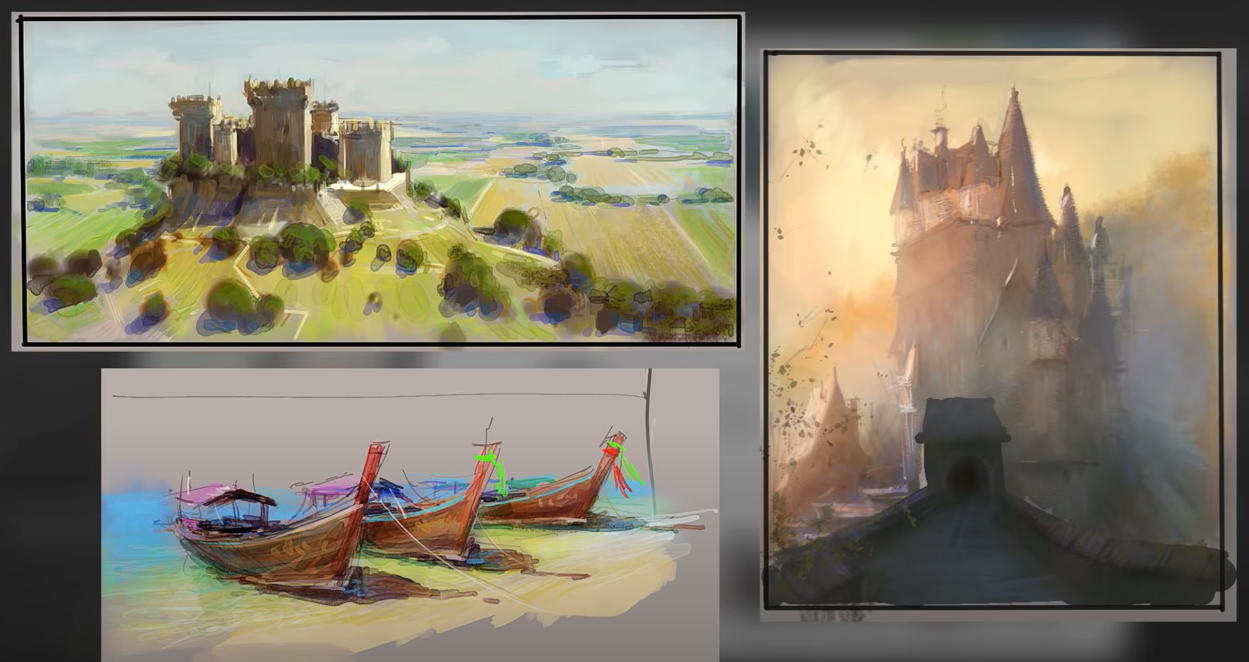
- Aeriform View Castle
-
- Making My List
- Paint Small
- Adding Depth: the atmospheric perspective
- Advanced Color Picking
- Boats on the H2o
-
- Painting Digital Watercolor Effects
- Shadows & Reflections
- Castle in Fog
-
- Selection Pen & Pixel Lock
- Fog Structure: Value Contrasts
Basic Clip Studio Paint Tools
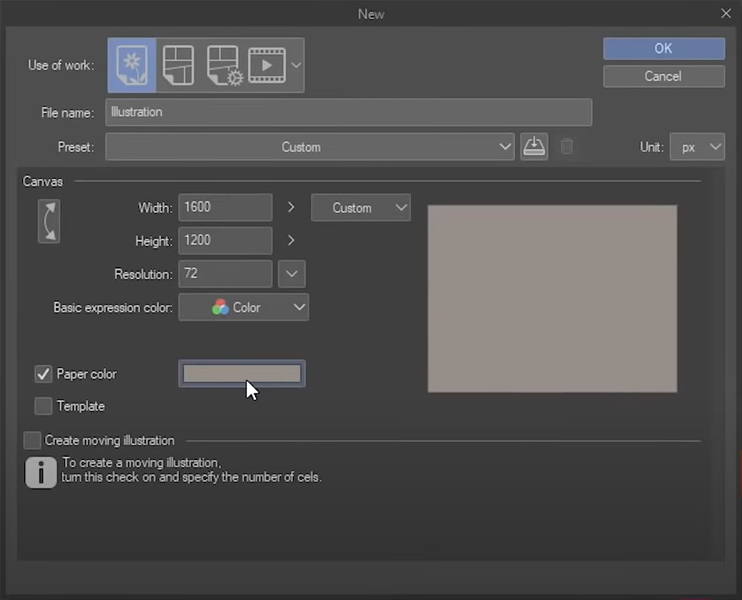
When you make a new canvas, you can set up a default paper color. I've set this neutral warmish gray as my default.
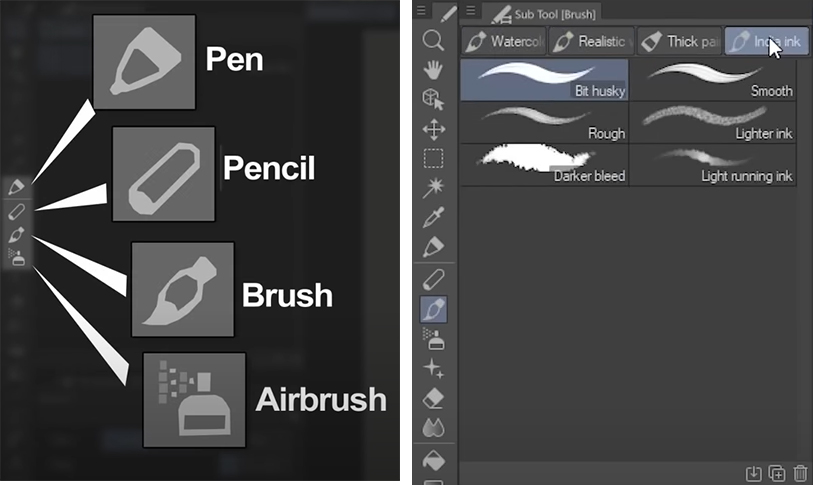
The primary brushes I use to paint with are located under these 4 icons. When y'all click on one of them, y'all will have further brush selections in the Sub Tool menu.
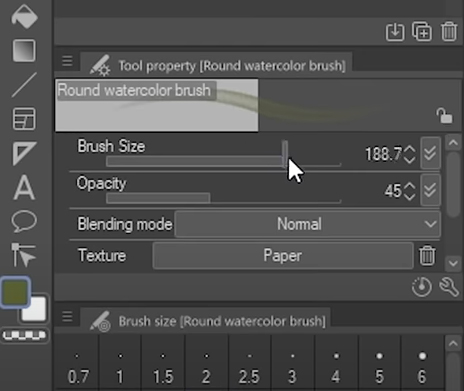
When yous click one of those, you can fine-tune that specific brush in the Tool Holding palette shown below. Options include castor size, opacity, the blending mode, as well every bit a bunch of textures yous can emulate. And what's nice is as I select a different brush, I become different customizable controls. When I work in Clip Studio, I tinker effectually in these areas a lot.
one. Aerial View Castle & Making My List
Here'due south a photo I'll do a study from.
Before I jump in and start painting, I discover it helpful to make a listing of things I desire to study.
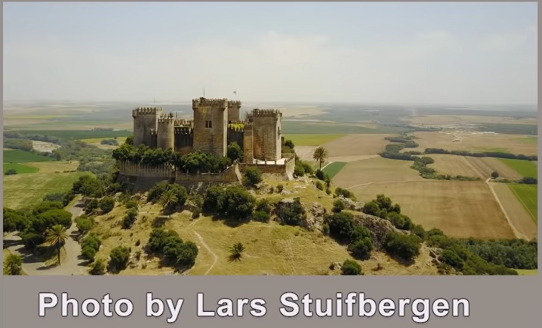
I similar the atmospheric perspective, specifically the challenge of tracking each color through depth. I think it will exist a real exercise in grays as those colors get a lot closer together back of the photo. I'd likewise like to become a sense of the non-repetitive patterns that nature makes, which I find quite hard to pull off. And I really similar the sense of the graphic punch on that castle. That'due south a clear focal signal right there, and I want to make certain it comes off every bit as articulate in my painting.
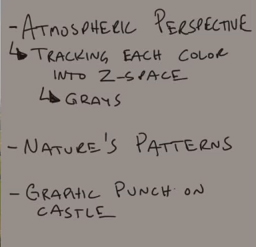
That simple listing volition continue me dialed in as I piece of work, and when I terminate that painting, I'll consult that list again and enquire myself, did I capture those things? So in a way, I've besides created a little rubric in which I can grade or cocky-evaluate my study.
Directly Line Tool
In Clip Studio Paint, if you put down a dot and so hold shift, it will give this interactive Straight line tool, which I find extremely helpful for blocking in a drawing or a basic composition.
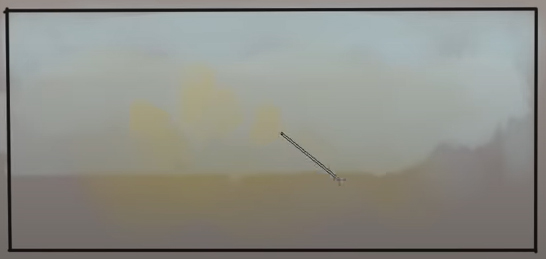
I'm using this tool to block in the castle and a lot of the surrounding landscape. The trees here I'll just freehand and referencing my list, this is my outset stab at nature's blueprint.
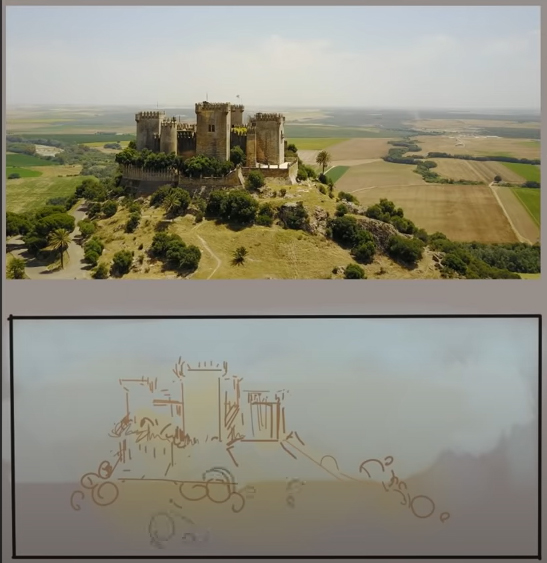
Ok, So I'm using brushes in the gouache collection to pigment the sky. Call up that I want to capture the graphic punch of the castle. And in social club to give myself an opportunity to do that, the sky should simply be dead simple.
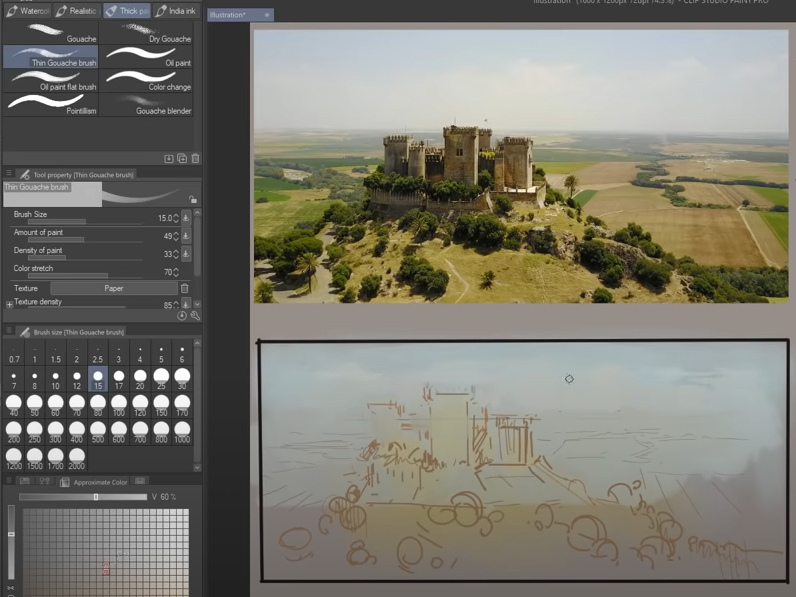
So, I've switched over now to the pen brushes, which tend to brand very bold marks, which I recall is a good choice to get this castle laid in. I've only been painting for a minute hither, and I'm already trying to satisfy one of the items on my list, the graphic dial on the castle, which brings me to my next piece of advice when studying from photos.
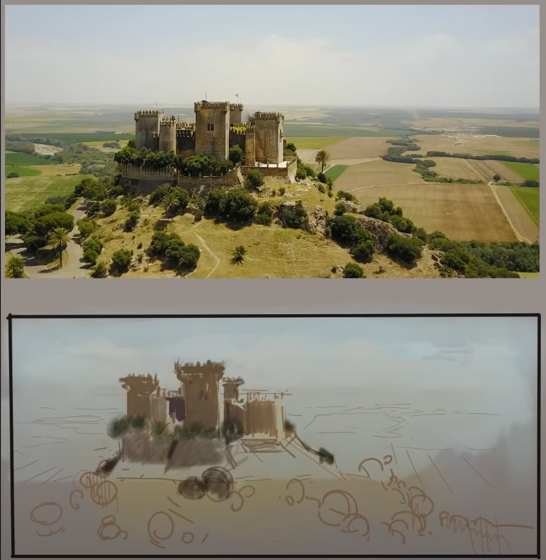
Ii simple words: Paint small
I've got two proficient reasons for this:
- Painting small in no mode inhibits your ability to make a skilful picture. And because painting small reduces the physical labor parts of painting a little scrap, you tin can become more than studies done in less time. So more studies, less fourth dimension, same pictorial impact, that's reason number ane.
- Reason number two surrounds some psychology I don't quite understand simply, painting small volition help steer you lot abroad from the common trend to just desire to copy everything.
And this is a common question I go from students. How do you lot avoid but copying a photograph and actually doing a conscious, focused study? Answering that question was really the driving force backside this video.
Calculation Depth
So at this signal in the painting, I'thousand dealing with the whole depth problem. That is the atmospheric perspective tracking all those colors equally they recede in space. I've been painting this stuff for many years now, and I'm aware of a design or two.
Allow'due south have three of the basic colors in this scene. The green of the trees, the green of the m, and that xanthous-sienna colour. Hither are their corresponding values.
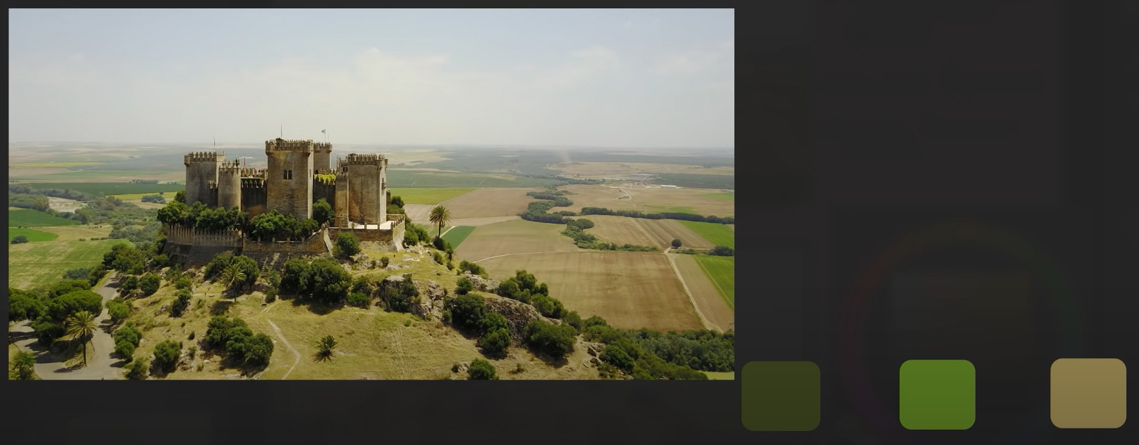
Now that represents those things close to the photographic camera. We need to know how they change as they recede. First, these things are all darker than the sky, and they take to stay that fashion. The values will get lighter with distance while however maintaining that relationship.
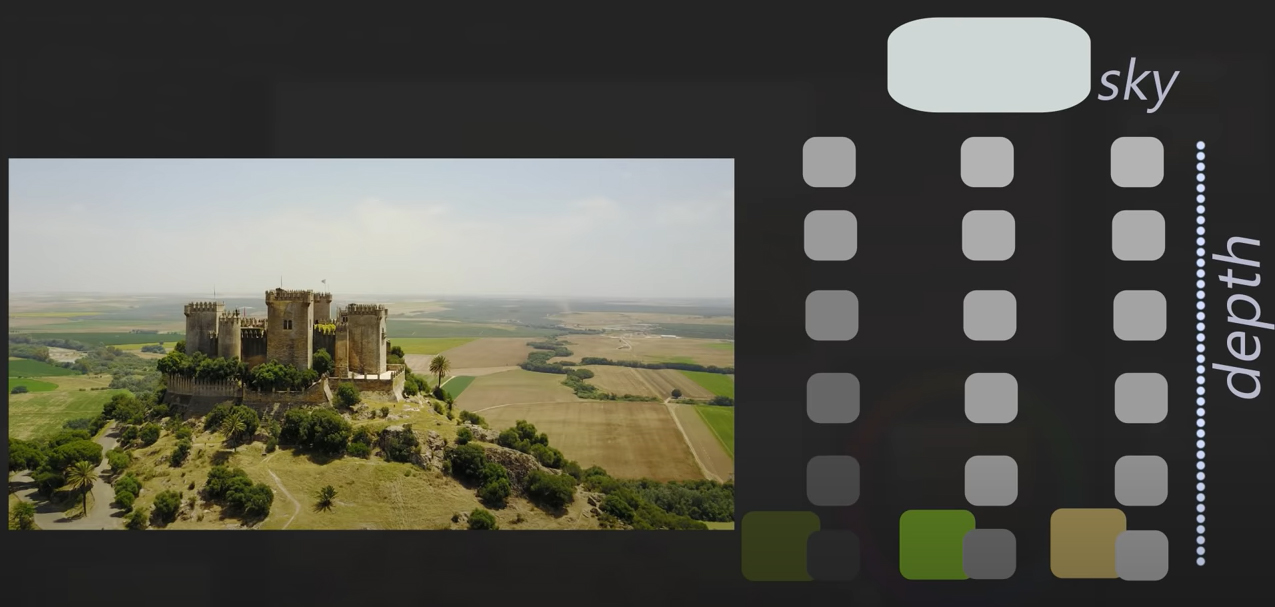
The things that are the darkest, the trees, in this case, feel the near modify merely because they have more values to go through. If yous can see right to the horizon similar yous can in this photograph, everything will eventually compress to the aforementioned value. The same is true with colour. We'll give the sky a faint blue every bit in the photograph. As the colors go further and further away, they'll be influenced by that sky color. I think that's uncomplicated enough to empathise. Getting the colors at that place, that's the catchy part.
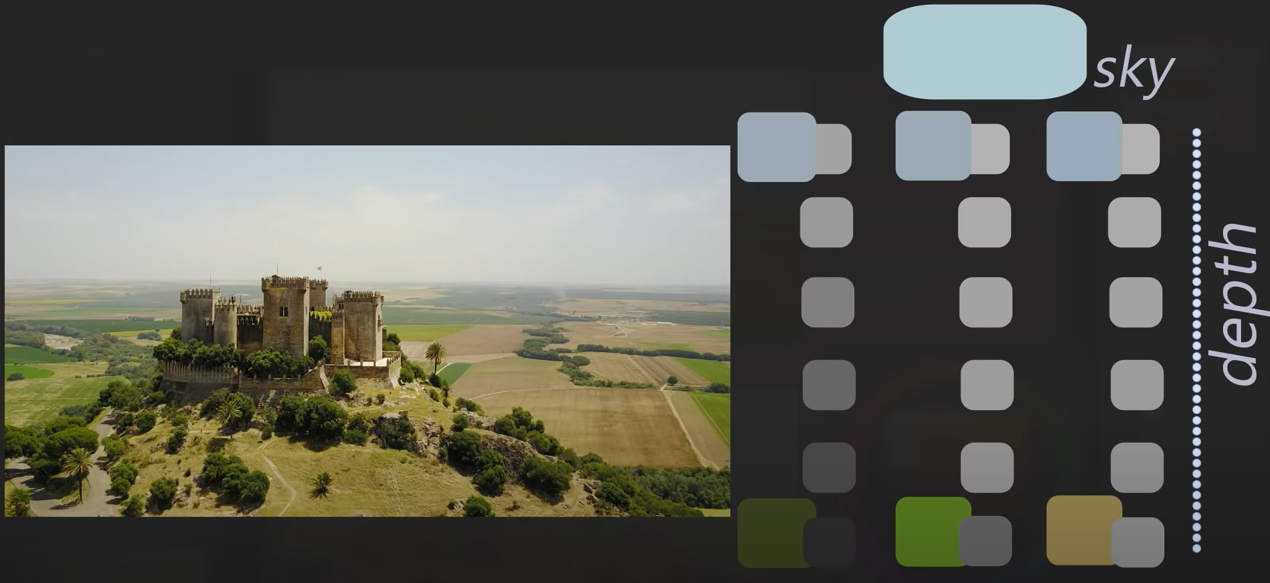
Tips: Color Transitions
Below you can see a color wheel. We accept 2 colors, the greenish and the orange, and nosotros want to somewhen get them blue.
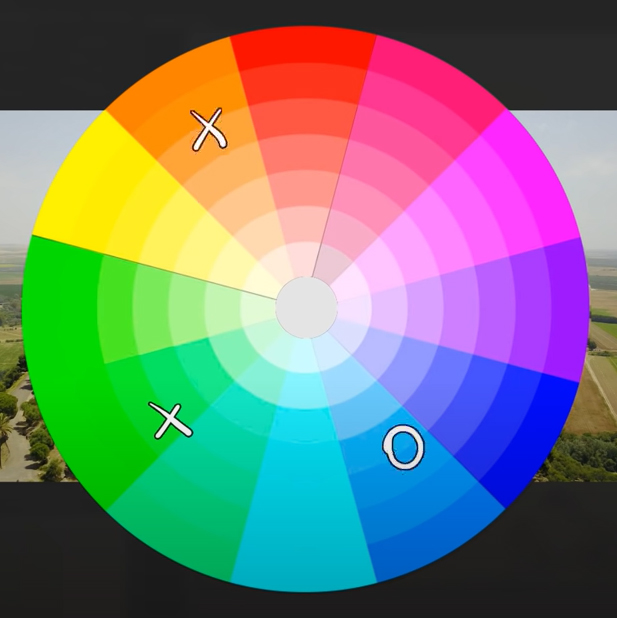
Allow's first with the orange; y'all might think information technology takes a path like this or maybe the other way like this.
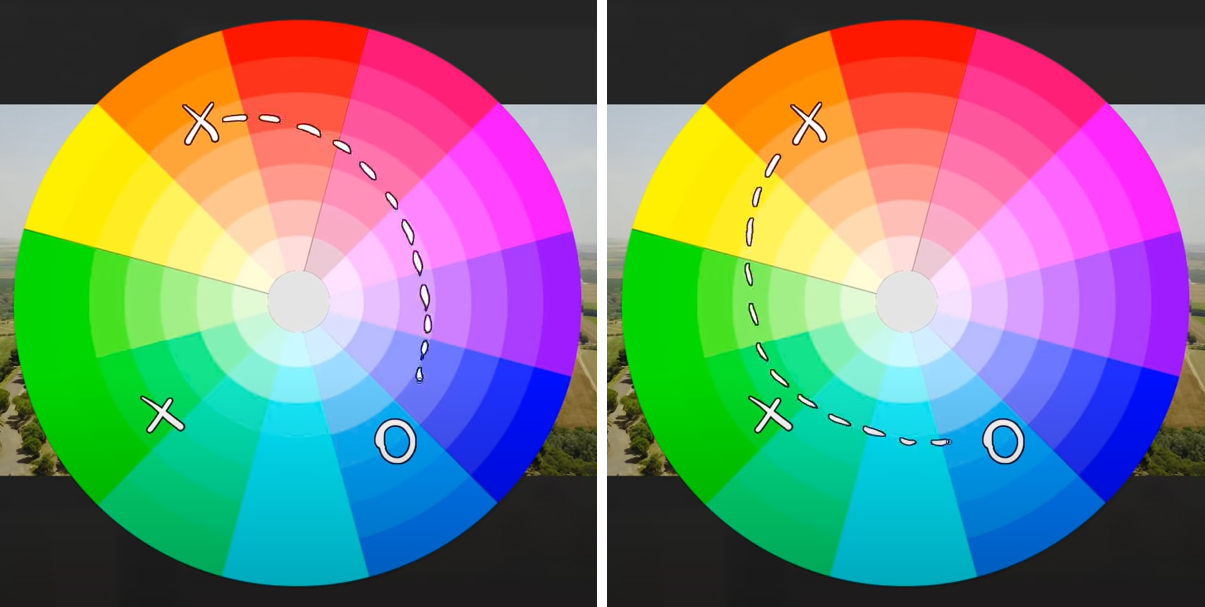
It really won't exercise either of those. Instead, it will become through gray, the area where all colors unite. The exact path it will accept tin vary, but it volition wait something like this. Similarly, the green is less likely to practise this and more likely to nautical chart this path.
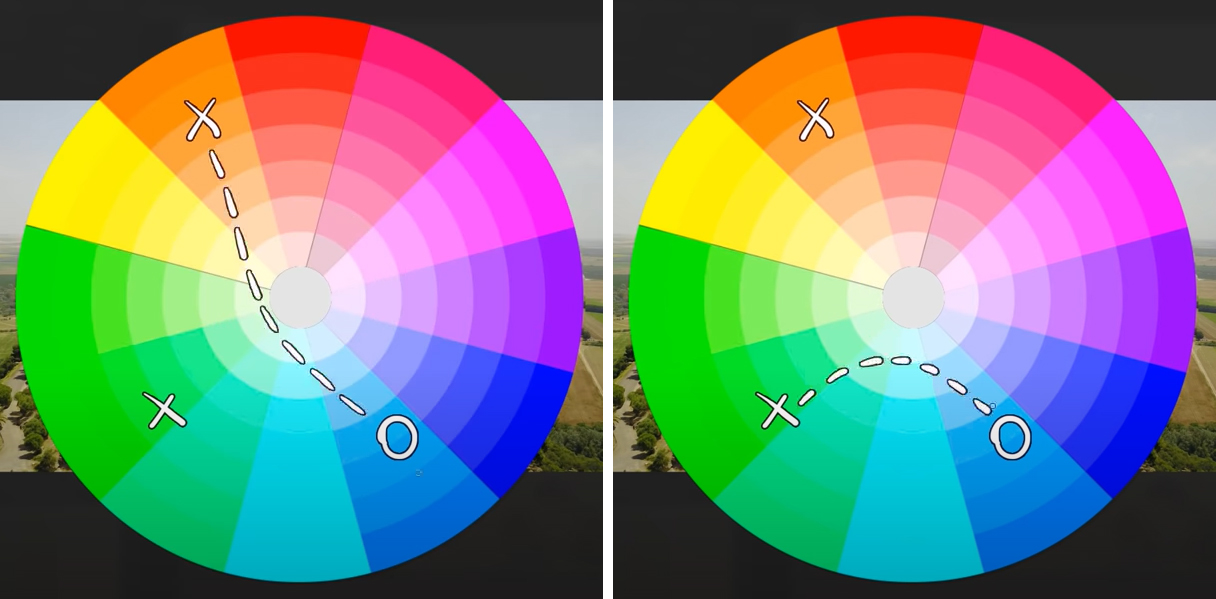
The colors don't have to pass through perfect grayness, but you can think of the gray as a kind of gravity well that, when information technology comes to depth, will pull colors toward it as they laissez passer by.
Back to our colour nautical chart hither, this is more or less what I'm going to be looking for.
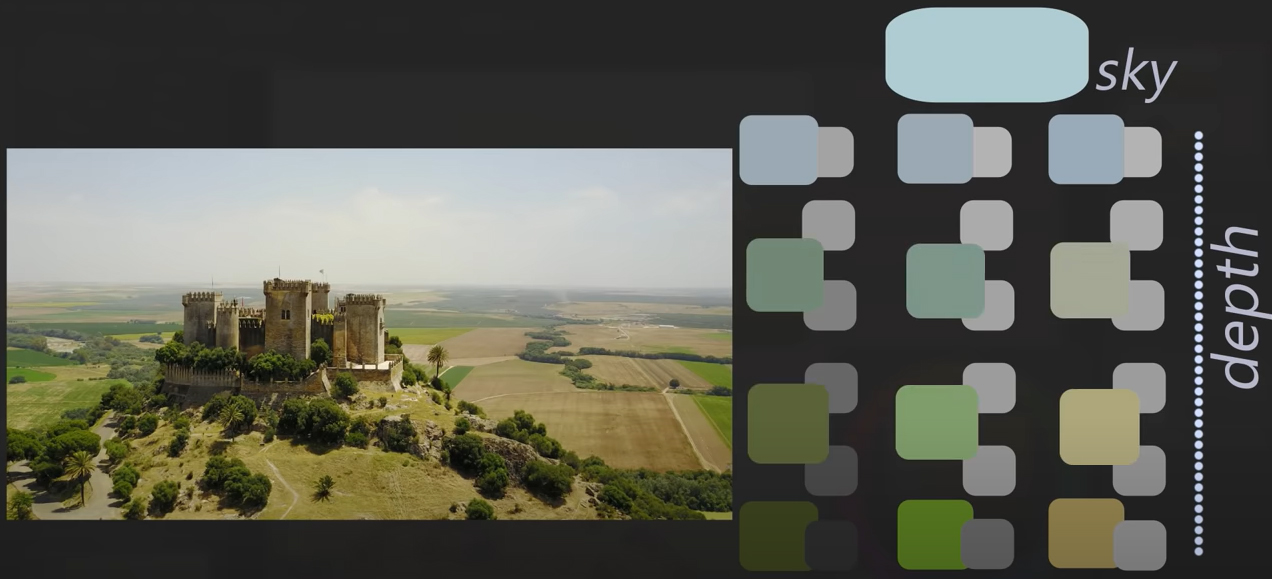
If you wait at what I have in the painting at this early stage, I've kind of bookended information technology. I have the close colors, and I take the far away colors, those beingness the two easiest parts, at to the lowest degree in my stance, and then as the painting progresses, I will fill in the hard heart.
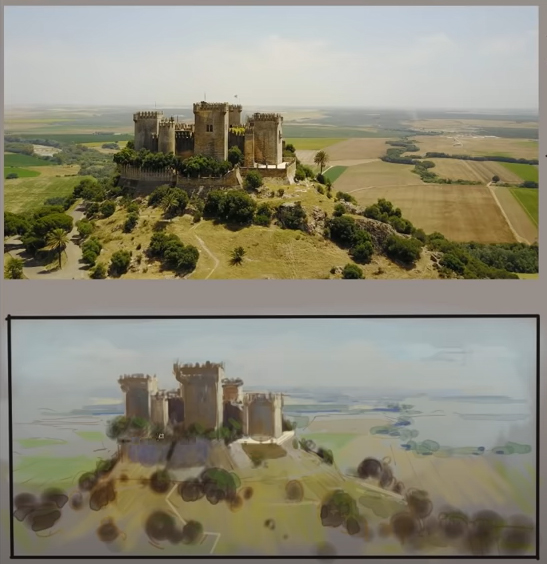
At the moment, however, I have parked all that in order to work on other things. I'm laying in the lite shadow on those trees, the bandage shadows they make onto the ground, refining the focal point and working on the other items of my list there. Find I'chiliad not overly concerned near the exact shape of those copse. That'due south because that'south not on my list. I'yard interested in the design, not necessarily the trees themselves, and then making those trees essentially dots of various sizes will still satisfy that detail on my list.
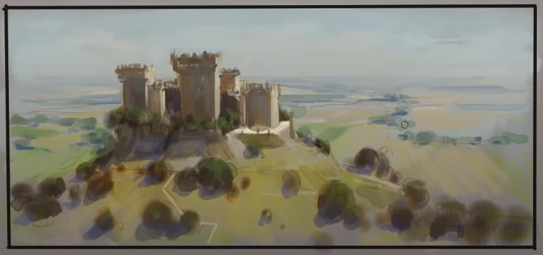
Ok, but switching gears now back to the atmospheric perspective stuff, I'm sifting through those colors that are responsible for the translation from foreground to background. Basically, I accept that color chart from a moment ago in my head and merely kind of searching for colors within those boundaries.
I'm using Clip Studio Paint's thin gouache brush and round watercolor brush for a lot of this. I find those 2 brushes really interact well with the colors already on the canvas. And that'due south actually important when it comes to painting atmospheric perspective considering y'all'll by and large exist doing a lot of little, trivial tweaks.
Avant-garde Color Picking
Speaking of footling tweaks, I really honey this colour picker in Clip Studio; it's kind of similar a magnifying glass for colour picking.
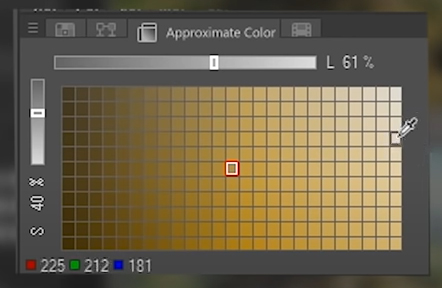
It's showing you a very close neighborhood of dissimilar saturations and different values, so if I wanted to lighten this and desaturate information technology only a tiny hair, I could click on that one. And, of course, that color updates on the primary colour picker and the color bike. You can also play with this luminosity slider, which sets how many values are displayed in this neighborhood. So if it's set to a loftier value, I accept access to a full range of values, and if it's set to a lower value, I can be very scalpel-like with these colors.
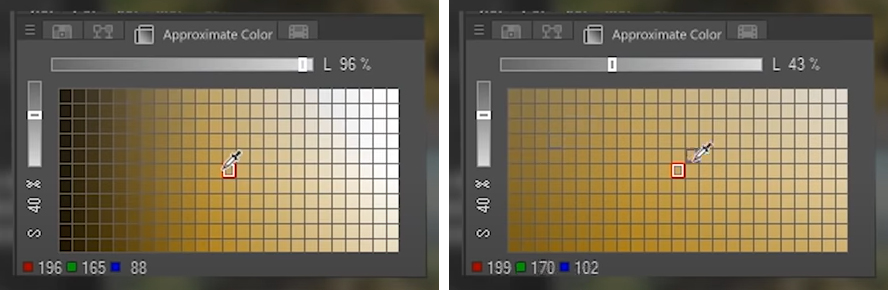
Another cool feature is, Let'south say I'm up here and I alter the color on my color wheel, it defaults me dorsum to the middle, and then I ever have a total range from left to right and up and downward to pick from.

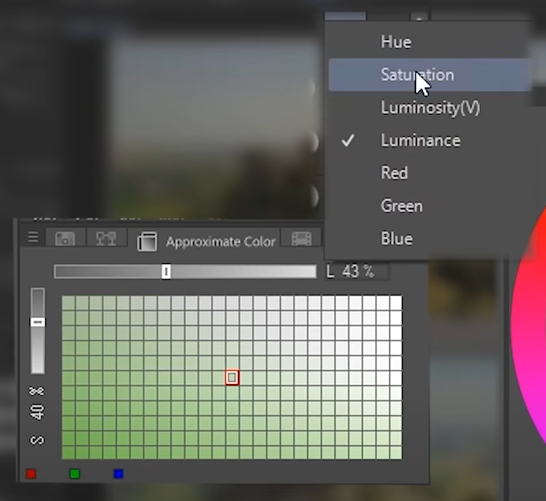
If yous click on the icon at the end of the slider bar, you can change what information is being displayed in this table, but I like the default, which is Luminance.
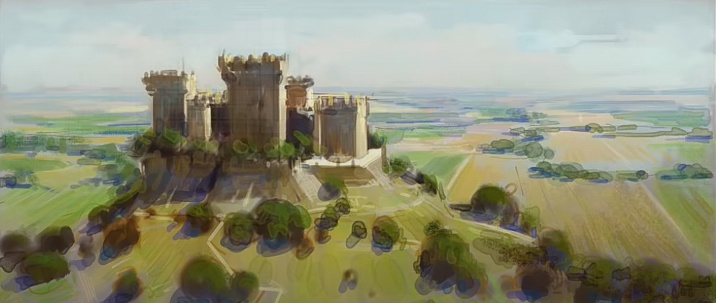
Hither's the finished photo study. It's modest; it didn't take too long, so let'southward practise some other ane.
two. Boats on the Water
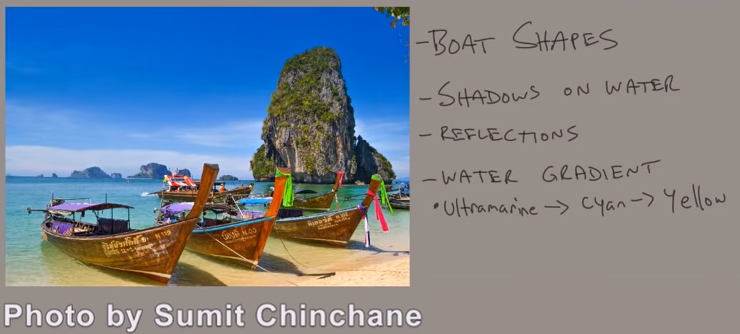
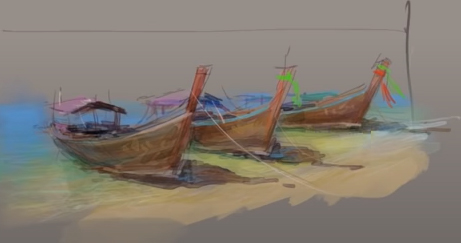
In this photo, I'm drawn to the deportment surrounding those boats, mode more than than the background. Not but the boats themselves only the shadows existence cast onto that shallow h2o, which is partially reflective. I besides merely honey the color gradient in that body of water water. Because everything in my list surrounds the boats, I don't even really need to compose this within a frame; I can just isolate the full general surface area of the boats and pigment it up from there and encounter what happens.
I'm using the soft airbrush tool here for the water, although I've set that airbrush to a pretty high caste of hardness, as y'all can come across in the castor settings box.
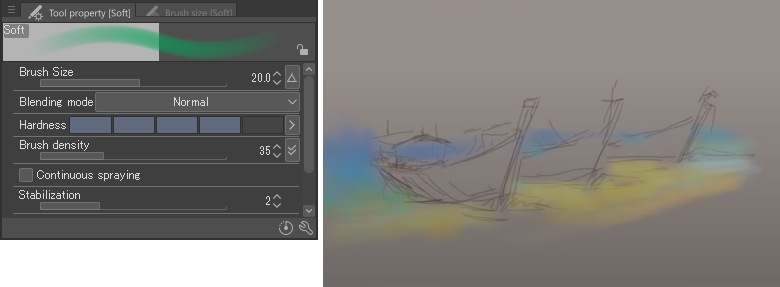
And I should mention that, while Clip Studio has all the layer functionality you would expect in a digital painting software, I like to only paint on i layer near of the time. I of the benefits of that is at present I tin switch over this round watercolor castor and set information technology to multiply mode, it'll collaborate with the other colors on that layer, and I can treat this as a watercolor painting.
Painting Digital Watercolor Furnishings
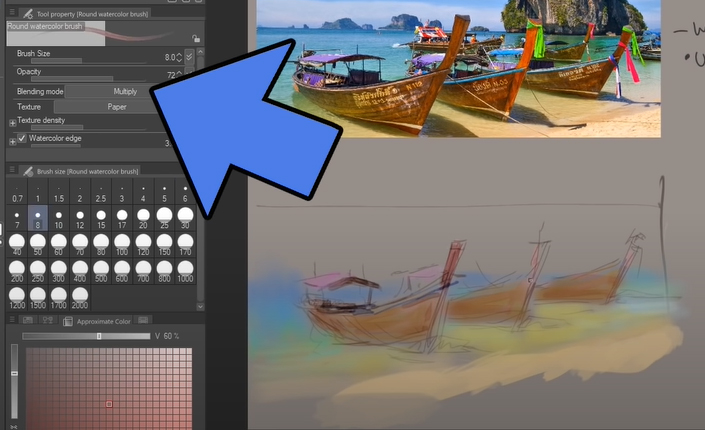
So I'm taking all those actually light colors that I started with and using this digital watercolor brush to go darker and darker. Very like to what I would practice with traditional watercolor. Setting the opacity low on this brush is similar to having a very wet wash, versus setting the opacity high volition recreate the furnishings of having more pigment on the brush.

If you lot've seen my videos before, you probably know this, but I practise a lot of traditional watercolors every bit well. So when a piece of software says it has a watercolor brush, I'm going to be pretty skeptical, simply Clip Studio's watercolor selection is pretty nice. You tin can get in expect and feel like traditional watercolor, but also y'all can reap the benefits of it being digital.
Switch your brush over to normal mode instead of multiply and brand it carry more opaquely. This is how I draw the ribbons, some of the light, caustic patterns in the h2o, and some general highlights on the boats and the lapping waves, etc.
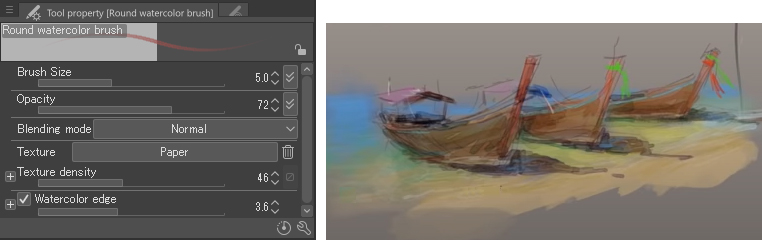
Shadows & Reflections
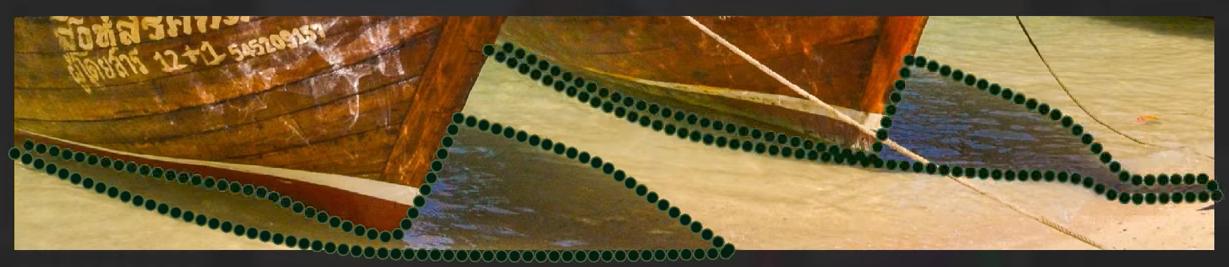
Anyway, on my listing, I said I was studying shadows and reflections, well, something very interesting is happening with those. If there was no h2o at that place, the shadows would more or less await like this.
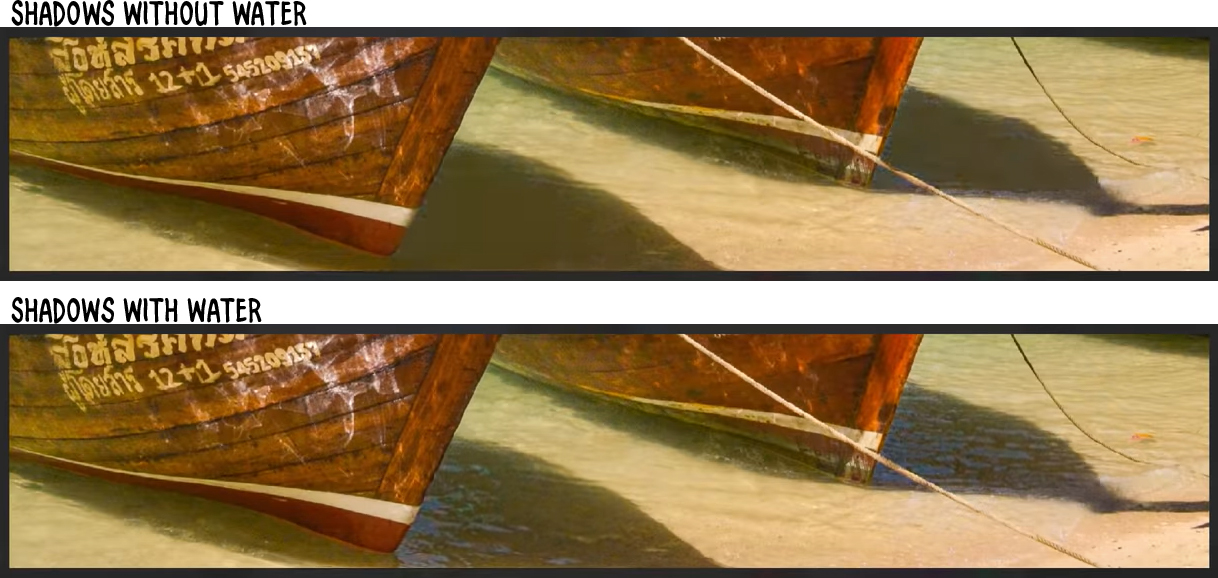
Just, because water is reflective and it'southward reflecting a light sky, the light reflections are battling with the dark shadow. And then, in this example, we will get a few lighter colors mixing in with our dark shadows.
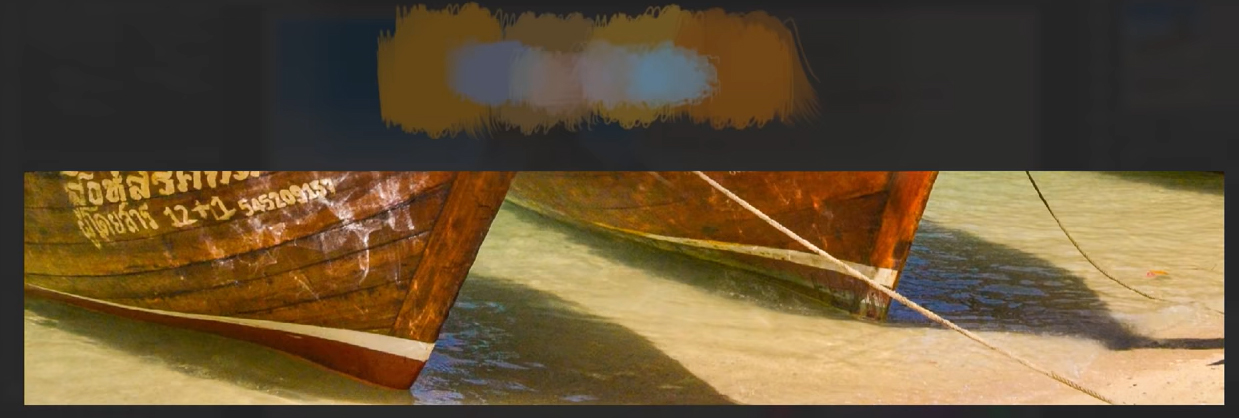
The thing to note, though, is the clarity of our shadow shapes is withal at that place.
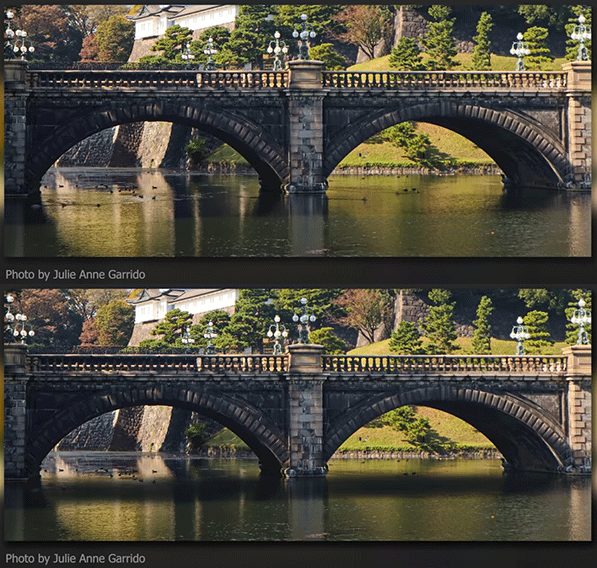
This doesn't ever happen, though. This bridge, for case, is casting a shadow on the water, just its shadows are being defeated by the reflection. Y'all really got to take this stuff on a instance-past-instance ground.
Now, if this was a full-size, fully-detailed painting, I might desire to go in there and capture every little shape of reflection, only that'due south not what I'm studying; I'g studying the optical effect of these things, and to that finish, painting small like this really helps me stay focused.
So, just putting a few finishing brush strokes on this. I call back I've captured the things I set out to capture, and that ways we're done with this one.
3. Castle in Fog
Alright, there's a cool photograph.
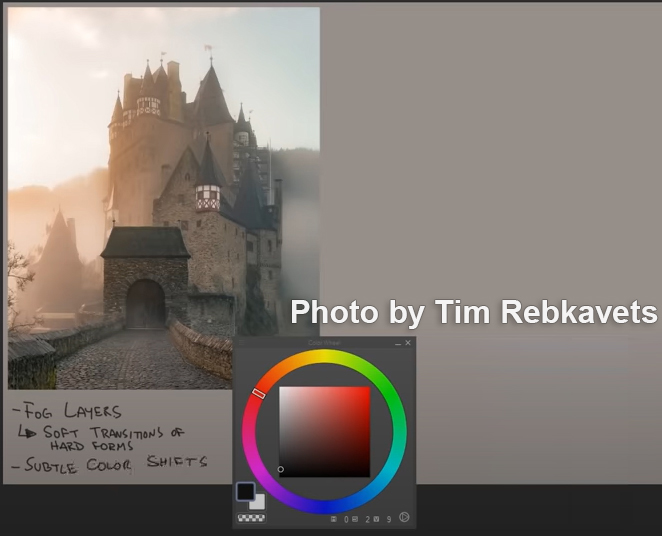
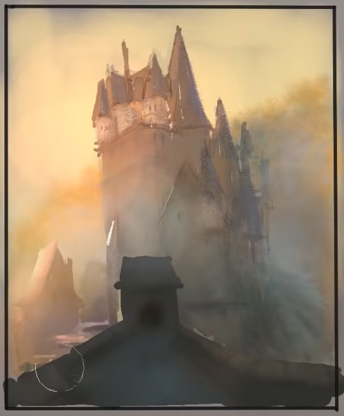
I obviously want to capture those layers of fog. The fog makes those hard castle forms feel very soft. I recollect it will be a nice challenge to go for that. And along with the fog, there are subtle transitions of color, kind of warmer on the left and color on the right.
Pick Pen & Pixel Lock
So I'thou using Clip Studio's Direct line tool to block all of this in. Now cheque out this characteristic hither; information technology's called the choice pen. It kind of looks like I'm painting green, but I'm not; the tool makes selections out of the areas that y'all pigment.
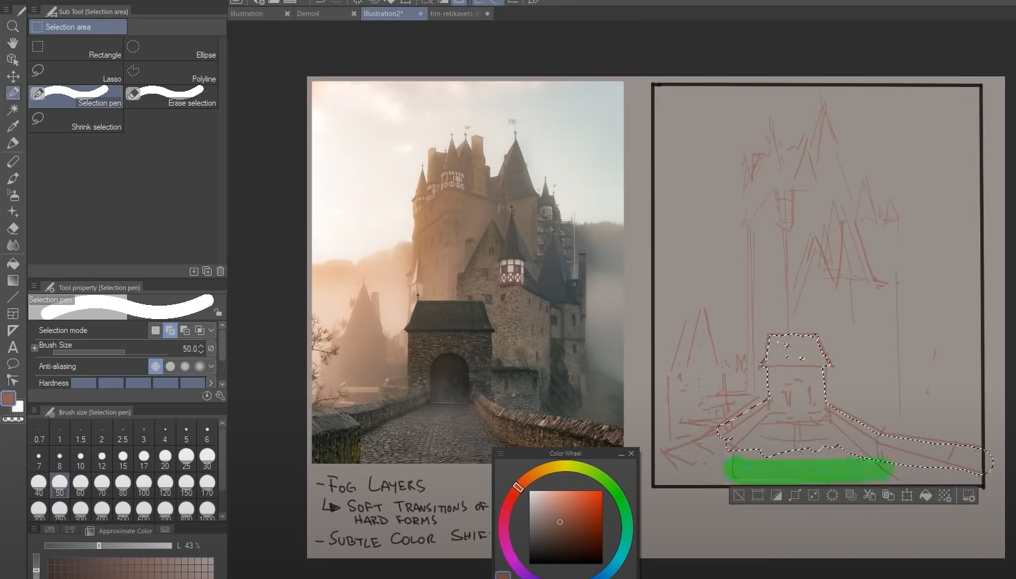
With that pick, I'll make a new layer and so go take hold of the pigment bucket tool and make full that in, just a flat color for now. I'll repeat that same process now for the large castle, and I'm non besides worried about those accidental negative spaces; I recall it will just add together to the amuse when I'yard done.
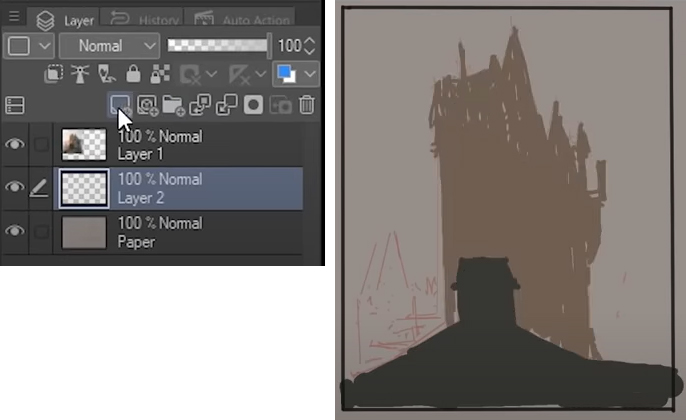
On the very showtime layer, I'1000 using this textured airbrush to block in the background trees—some other layer for that little business firm on the left.
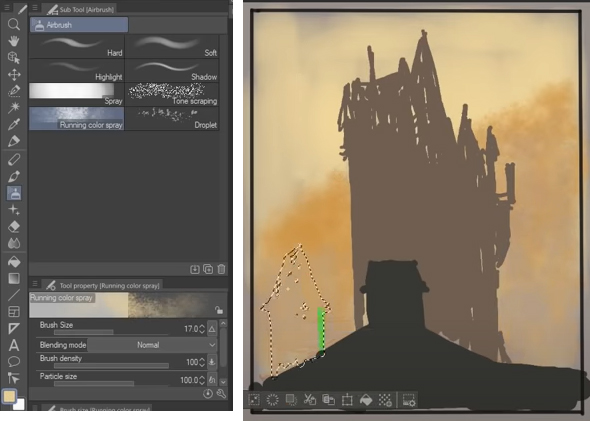
I'll select the main castle layer, and I'll button this button hither that allows me to pigment with this very big airbrush, which I'm setting to glow dodge style; anyway, I tin paint with a large brush, and it locks my painting to the pixels that are already on that afterward. The upshot is, my castle selection stays intact.
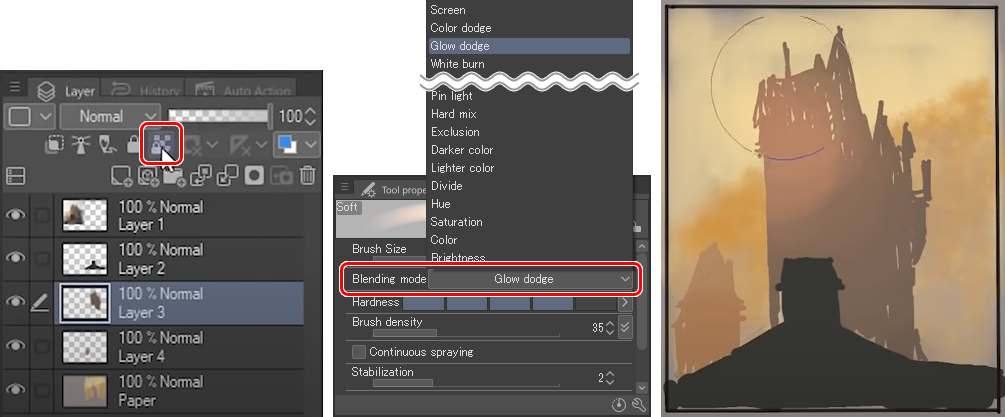
And that's what I'll do to go on blocking in this scene: switching layers, locking the pixels, and and then painting with a soft airbrush into information technology.
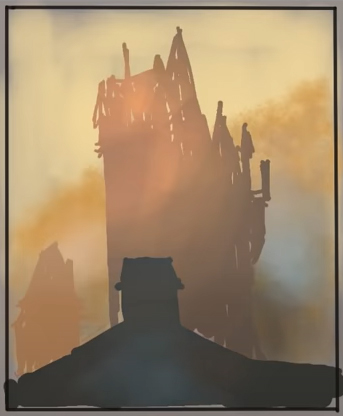
This is already steering me in the direction of fog, but I don't desire everything to be so soft, for case, these rooftops I'k carving out with a round watercolor castor. I'll keep switching around to find other rough brushes to help me offset the effect of the airbrush.
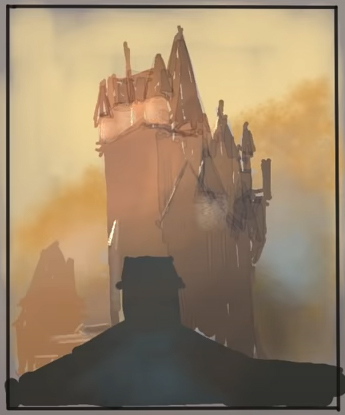
At present that the forms are being developed, it's critical I capture that subtle color shift I mentioned in my list. Warm in the upper left then cooler as we go down into the right. I'll utilize various airbrushes to block that in.
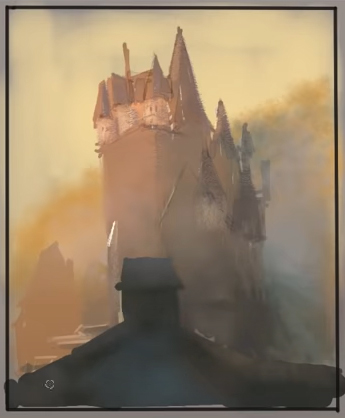
At present that I accept that, I can get after some subtle features, like the little windows, the ambient occlusion under the roofs, and further obscuring the forms with more fog.
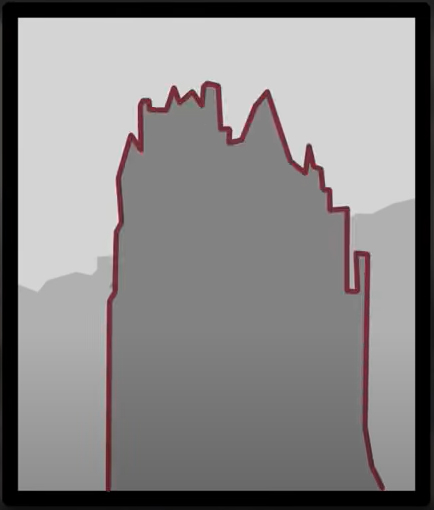
Fog Structure
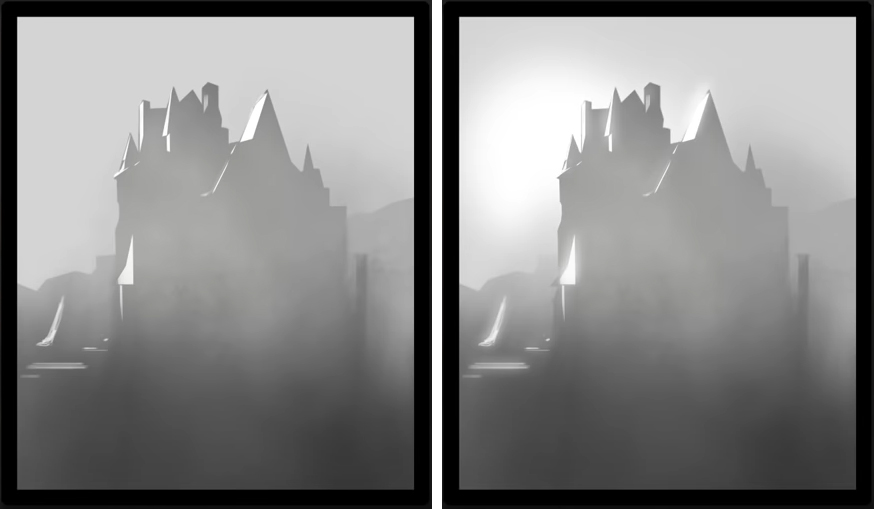
I want to quickly hash out the general structure backside painting fog. Y'all can start with a articulate silhouette like this as a block-in merely have a bones structure in mind as yous obscure it with fog.
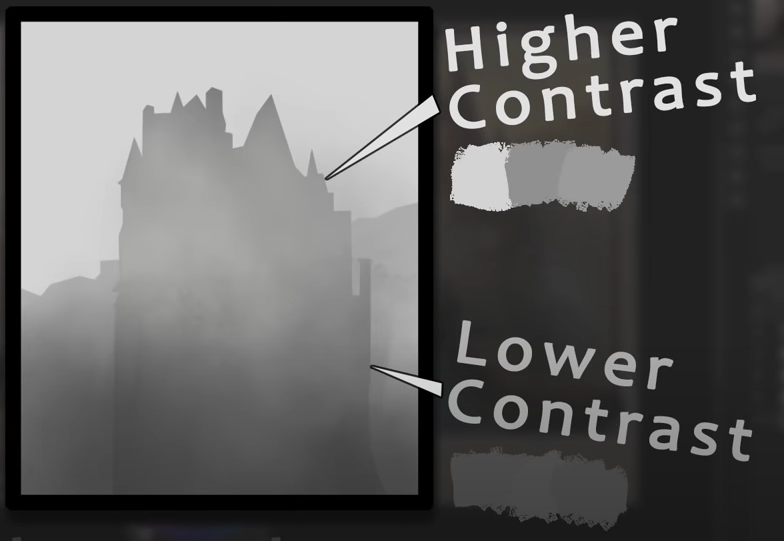
Commonly you'll run across this kind of construction, where the silhouette remains clear at the tiptop but becomes less contrasty and therefore softer below.
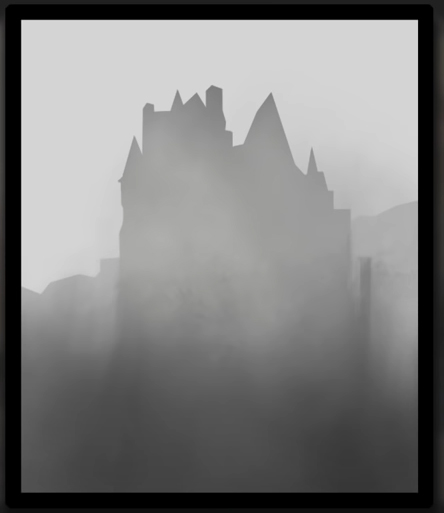
Y'all could totally even lose these edges similar this depending on how foggy you want your scene to look. Merely brand sure if you do that, y'all're maintaining your bones structure.
At present, if light is coming in at an oblique angle like it is here, the brightest lights can pierce right through the fog, making for very clear hard-edged shapes. And to sweeten information technology further, you tin can add a flake of glow effectually the lights and play effectually with some minor value variation.
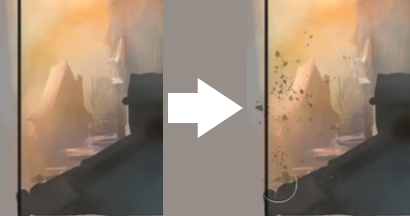
Then getting back to the study, yous can see how I've congenital it on that unproblematic structure, so, of course, y'all can add whatever frills or details on top of that. Hither, for instance, I'm using a spattery airbrush to block in a bush on the left.
Now I have the pastel brush, and I've chosen a newspaper texture for information technology that kind of mimics the bricks on that castle, and I observe that with a big enough castor size, I tin get both an airbrush-like effect but with a hard edge texture. It's an interesting combination that happens to work for bricks in fog.
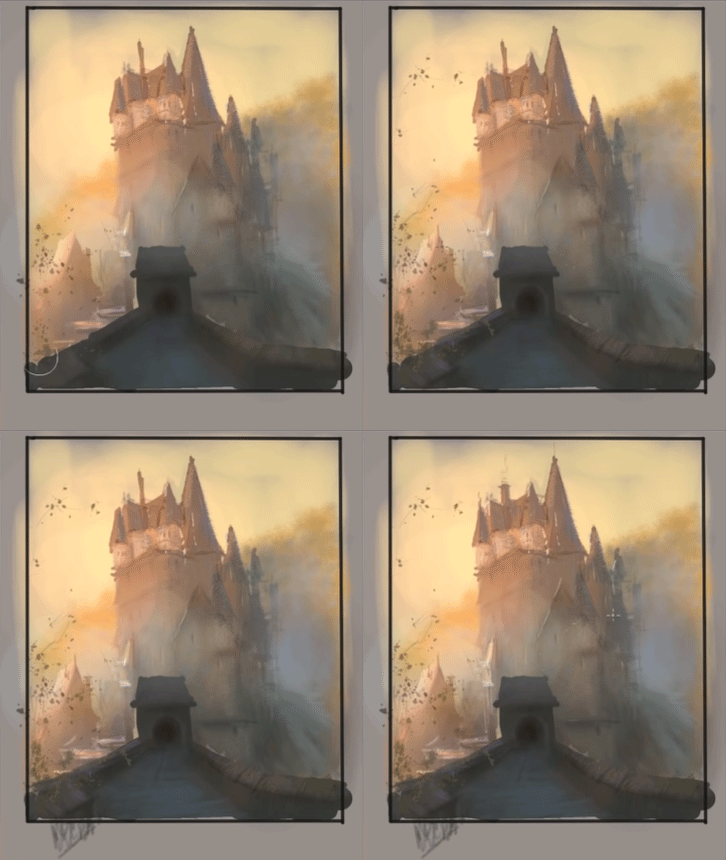
Anyway, I think I'll leave information technology at that place.
I promise this tutorial tin can inspire yous with your photograph studies and get to clip studio.net and go yourself a complimentary trial of the software, whether you're a student or a professional, I think you'll really like it.
Nearly the Artist
Marco Bucci recognized 2 things at a young historic period. The showtime was that he wanted to get a professional artist. The second was that he couldn't draw. This delayed him for quite some fourth dimension. He filled that time pursuing other artistic interests such every bit music and writing, only the urge to depict never left him. At historic period xix he began to study classical drawing, which led him to kindle a love for painting and analogy. He hasn't looked dorsum since.
Marco's experience includes books, moving-picture show, animation, and advertising. His clients include: Walt Disney Publishing Worldwide, LEGO, LucasArts, Mattel Toys, Fisher-Price, Hasbro, Nelvana, GURU Studio, C.O.R.E. Digital Pictures, Yowza! Animation Inc., Pipeline Studios, and more.
Marco is likewise a passionate teacher, and currently teaches "The Art Of Color & Calorie-free" at CGMA, a course specifically designed to build painting fundamentals from the ground upwards.
Marco is available for freelance piece of work on projects big and small! Feel free to electronic mail – marco@marcobucci.com – or find him through his representation, Shannon Associates LLC.
Social Media
- Patreon: https://www.patreon.com/marcobucci
- Instagram: https://world wide web.instagram.com/bucciblog
- Website: https://www.marcobucci.com

How To Draw Landscape Digital Painting,
Source: https://www.clipstudio.net/how-to-draw/archives/163907
Posted by: shroyerplasoner.blogspot.com
0 Response to "How To Draw Landscape Digital Painting"
Post a Comment